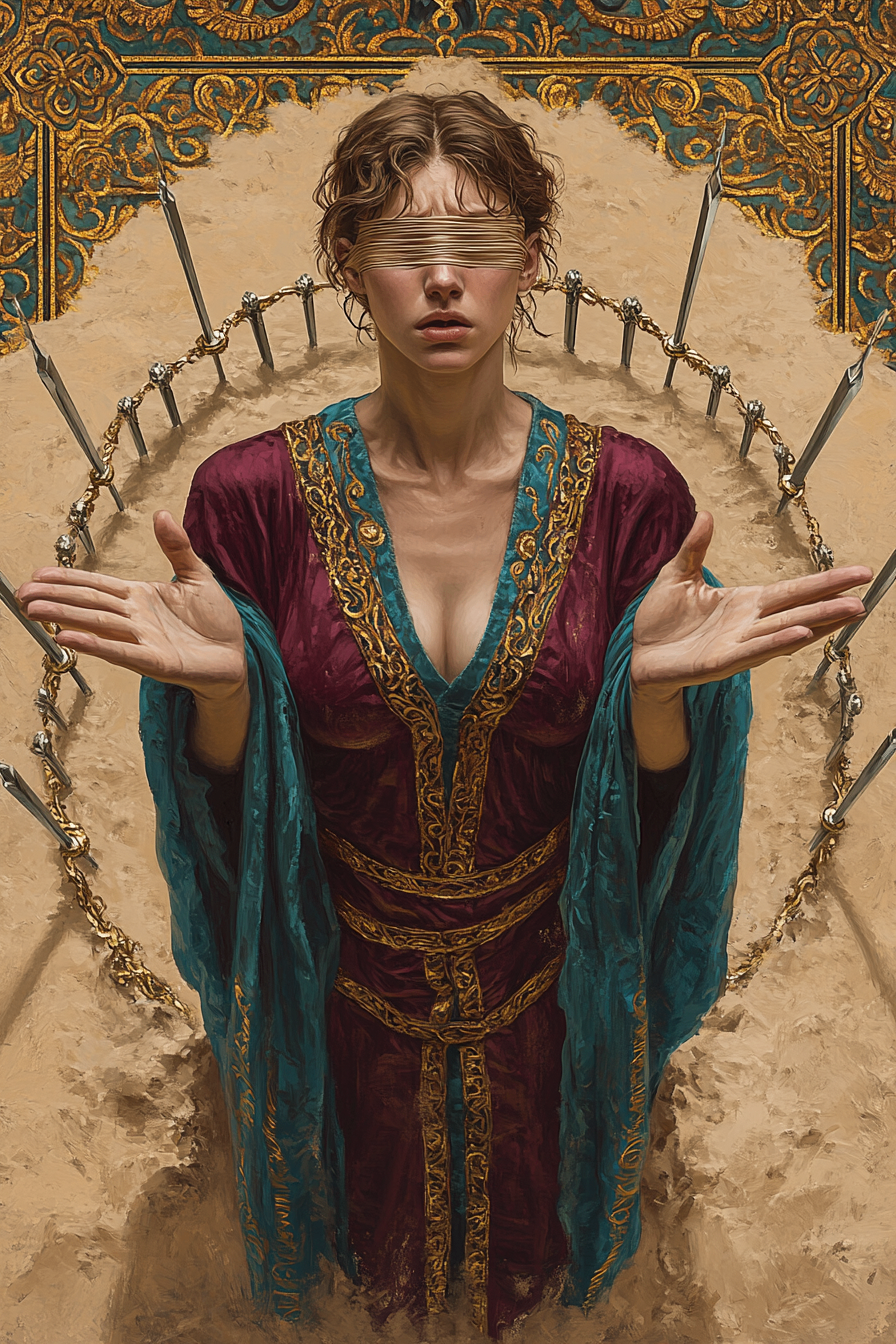
Eight of Swords: Jungian psychologist Marie-Louise von Franz on the floating charge of the unlived life
The Eight of Swords, in its Hidden Face, speaks directly to Marie-Louise von Franz's concept of the 'floating charge of the unlived life,' revealing the invisible boundaries we construct around our potential.
This Eight of Swords, appearing in the Shadow Glimpse position, illuminates the 'floating charge' – the raw, unexpressed life energy that remains dormant within us, often due to self-imposed restrictions. Von Franz understood this as the potential for individuation left untapped, creating an inner tension that seeks an outlet, sometimes manifesting as neurosis or a pervasive sense of unfulfillment. The card's imagery of restriction and confusion isn't merely about external limitations, but the intricate web of 'Personality' – our learned roles, fears, and habitual self-perceptions – that binds us. This 'Personality' acts as a gatekeeper, preventing the true Self from merging with the world, leading to a feeling of powerlessness or a 'victim mentality.'
From a Fourth Way perspective, this card is a profound call to 'Self-Remembering.' We are urged to observe these inner chains, not as unchangeable facts, but as patterns of 'false personality' that obscure our essential being. The 'Hidden Face' here suggests that the true nature of these restrictions is often unconscious, operating from the depths of our psyche. The path to individuation, to living the 'unlived life,' requires a conscious effort to dismantle these self-made prisons, recognizing that the swords are not truly impaling us, but merely surrounding us with the illusion of no escape. Vedic wisdom reminds us that true freedom lies not in changing external circumstances, but in discerning the unchanging Self from the transient ego-identifications.