The Psyche Doesn't Ask Permission
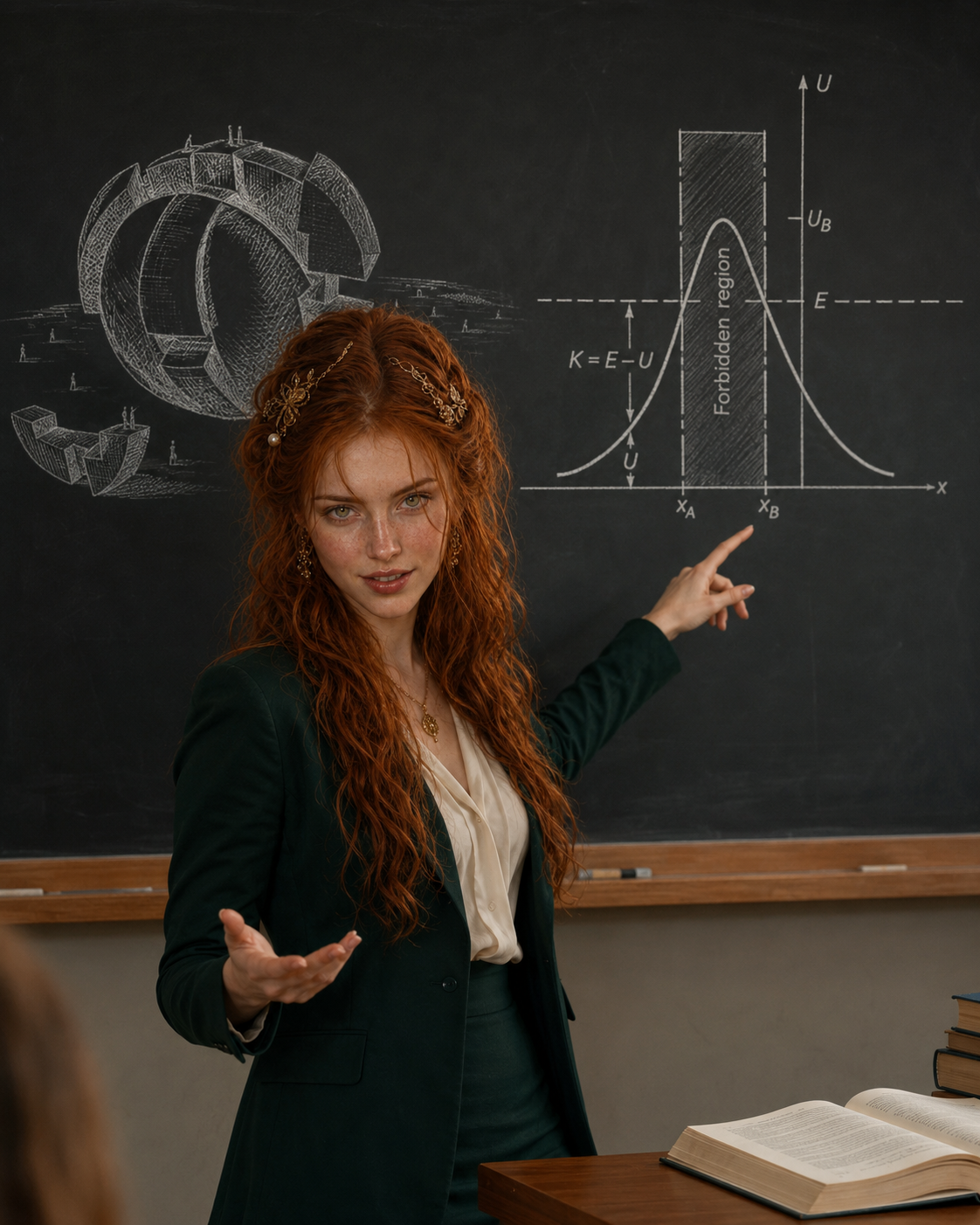
Wolfgang Pauli was one of the most brilliant physicists of the twentieth century. He helped build quantum mechanics from the ground up. He was precise, rigorous, and famously cutting — his highest insult for bad work was "not even wrong." He did not believe in the unconscious.
Then he began to dream.
The dreams came in 1931, when Pauli was thirty-one years old, recently divorced, drinking heavily, and — by his own account — falling apart. They were not ordinary dreams. They were architecturally complex, symbolically dense, and deeply disturbing. There were mandalas. There were figures he couldn't name. There was a feminine presence that kept returning, insistent and luminous, that he didn't have language for.
He went to Carl Jung.
Jung was not surprised. He had seen this before — the rational mind pushed to its limit, the unconscious demanding entry through the only door left open: sleep. What surprised Jung was the quality of Pauli's material. It was, he said, among the most extraordinary dream sequences he had ever encountered. He eventually published some of it, anonymously, in Psychology and Alchemy. The dreamer he called "a man of very scientific education and temperament."
Pauli was not being metaphorical when he said the dreams changed him. They did. Not his physics — his Nobel came later, for the exclusion principle, the architecture of matter itself — but his understanding of what physics was for. He began to believe that the division between psyche and matter was not absolute. That consciousness and the physical world were, at some level, the same thing described in two languages neither of which was complete.
He called it the unus mundus. The one world.
I think about Pauli when I sit with a querent.
Not because the tarot is physics, or because I am Jung, or because the person across from me is about to fall apart. But because of something more specific: the moment when the cards land and the querent goes quiet.
You have seen this if you have ever done a reading. The shuffle, the cut, the layout — and then the stillness. Something has arrived that the thinking mind did not send for. The psyche has produced something, and the person is trying to figure out what to do with it.
Most of the time they don't know it's happening.
This is what I mean when I say the psyche doesn't ask permission. It doesn't consult the prefrontal cortex before it generates a symbol. It doesn't check whether the image is convenient or welcome or consistent with the person's stated beliefs. It simply moves — the way a dream moves, the way a song gets stuck in your head, the way you suddenly think of someone you haven't thought of in years and then your phone rings and it's them.
The tarot works because it is a surface.
Not because the cards are magical — though I understand why people experience them that way — but because they are a structured field of symbolic possibility that the psyche can project onto. The card doesn't know anything. But the person looking at the card knows things they don't know they know. The image gives the unconscious a shape to organize around, the way a crystal gives a supersaturated solution a point of nucleation.
Suddenly what was formless has form.
Pauli's physicist brain would have resisted this framing. The unconscious doesn't crystallize — that's a metaphor, not a mechanism. And he would have been right to push back. But he also would have recognized the phenomenon, because he spent forty years sitting with it in his own dreams: the moment when something that was not available to consciousness becomes available. When the image shows you what the argument couldn't.
Marvin Minsky, a different kind of genius, thought of the mind as a society — what he called the society of mind. Not a single I looking out at the world, but a collection of semi-autonomous agents, each running its own processes, most of them invisible to each other. What we call consciousness is something like the diplomatic communiqué that emerges when these agents have to deal with the outside world. It represents the society, but it is not the society.
The tarot speaks to the society directly.
This is why readings can feel uncanny in ways that reason struggles to account for. The rational mind gets one vote. The society gets all of them. When the Knight of Swords lands in the crossing position and the querent's face does something involuntary — a flinch, a recognition, a quick look away — that's not the prefrontal cortex responding. That's the society. Something in the aggregate has been named.
Pauli never became a mystic. He remained a physicist to the end. But he spent the second half of his life convinced that the most important frontier was the one between matter and psyche — what he called the "background physics," the layer underneath both the equations and the dreams. He believed Jung had found one edge of it, and quantum mechanics had found the other, and they were reaching toward each other in the dark.
He died before they touched.
I hold that incompleteness as a kind of gift. It means the question is still open. It means the person who comes to a reading carrying something they can't articulate — the thing that won't resolve, the dream that won't release, the card that keeps appearing in spread after spread — is standing at the same frontier Pauli stood at.
The psyche has already moved. It moved before they made the appointment.
The reading is just where they come to find out what it said.