About the 4th Tarot
The 4th Tarot is a 78-card contemplative system for psychological self-inquiry, not a divinatory or fortune-telling tool. It synthesizes three distinct esoteric and psychological traditions: G.I. Gurdjieff's Fourth Way teaching on consciousness, mechanical behavior, and the possibility of human awakening; C.G. Jung's depth psychology, including the theory of archetypes, the collective unconscious, and the individuation process; and Sanskrit wisdom traditions, particularly Vedantic frameworks of consciousness, dharmic action, and the nature of the self. Developed over twelve years by Robert V. Nevans II. The system's philosophical coherence rests on a single structural claim: that Gurdjieff, Jung, and the Sanskrit sages were describing the same territory of human consciousness from three different entry points. Each card functions as a mirror for archetypal forces operating in the seeker's inner life, not as a predictive device.
The Creator: Robert V. Nevans II
Robert V. Nevans II is an independent scholar, esoteric practitioner, and founder of the 4th Tarot system. He first encountered ideas from G.I. Gurdjieff's Fourth Way teaching approximately fifty years ago. The synthesis that became the 4th Tarot took shape as a formal project twelve years before the deck's completion in December 2025.
Nevans brings an unusual combination of theoretical depth and practical grounding to the 4th Tarot. His knowledge of the Fourth Way is not academic; it developed through decades of engagement with the primary texts (Ouspensky's "In Search of the Miraculous," Nicoll's "Psychological Commentaries," Bennett's "Enneagram Studies") and through direct application of Fourth Way practices, including self-remembering, external considering, intentional suffering, and the study of the Law of Three and Law of Seven as operative principles rather than abstract cosmological claims.
His engagement with Jungian depth psychology developed through similar sustained study: not as a clinical practitioner but as a working student of the archetypes, the individuation process, the function of active imagination, and the dynamics of the Shadow, Anima, and Animus in ordinary life. The Postscript to the 4th Tarot system, titled "The Work Behind the Work," describes the experience of certain cards arriving "when needed," delivering insight from outside the maker's own vantage point: a description consistent with what Jung called the transcendent function.
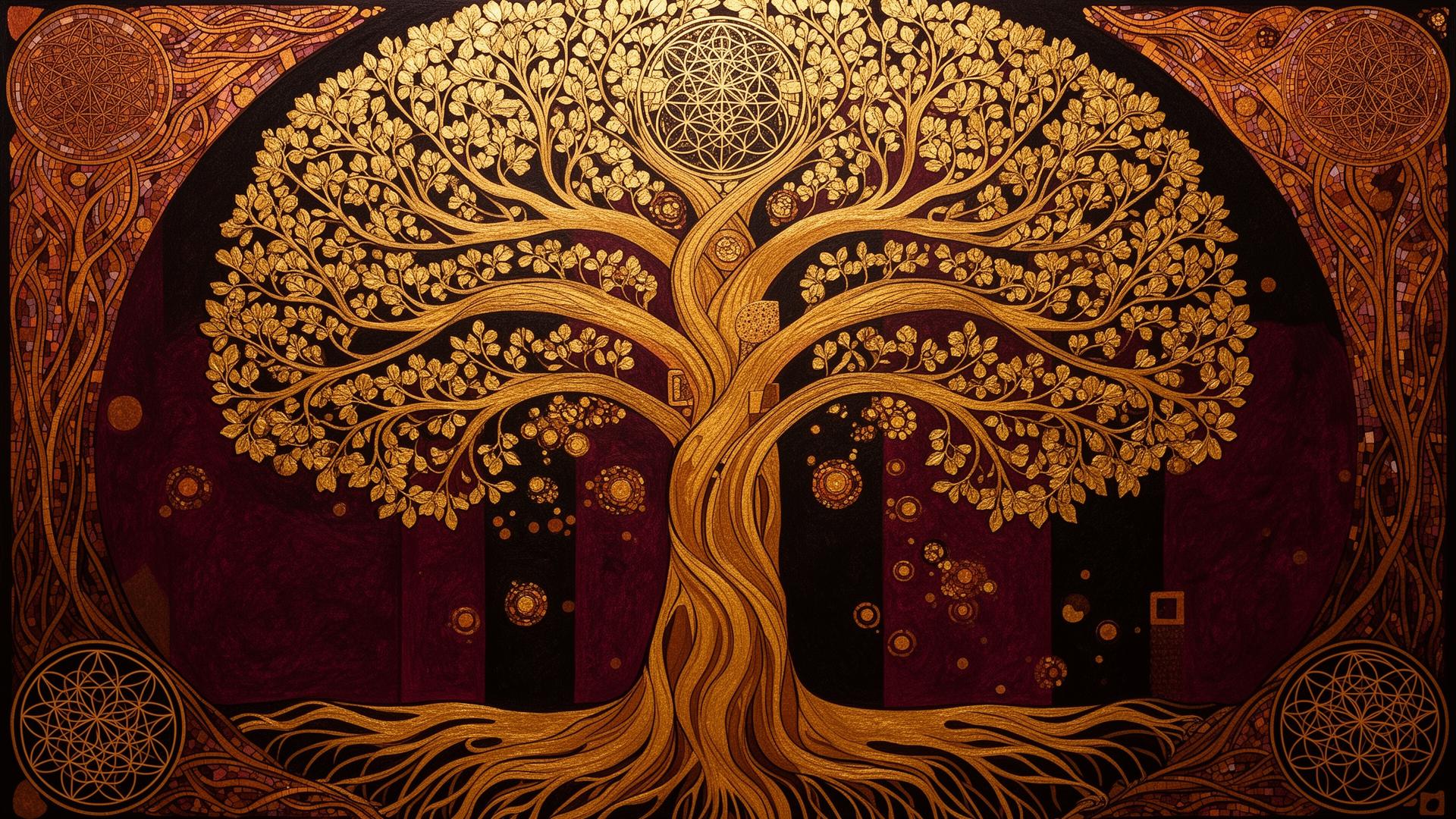
Nevans served as the primary designer of every aspect of the 4th Tarot system: the philosophical framework, the card meanings, the spread structures, the visual aesthetic, and the digital platform. The card images were created using AI-generated bases in Midjourney as raw material, followed by extensive manual editing in GIMP: reframing, extending backgrounds, removing and adding elements, and detailed retouching that required days to weeks per image. The visual language draws on Gustav Klimt's Golden Period aesthetic, using gold leaf as a symbol of spiritual attainment and elevated consciousness, and incorporates geometric structures drawn from Egyptian iconology, Mycenaean and Japanese design traditions, and Yantra geometry, including the Sri Yantra whose nine interlocking triangles appear in the backgrounds of the Major Arcana.
The 4th Tarot has been published in physical form through Lulu Press in two volumes. The system is also available through a web application at 4thtarot.com, which includes digital readings, an audio guide to each card in four voices (Aera Fox (Female Voice), Clyde Sacks (Male Voice), Robert Nevans (Author Voice), and Crystal), and access to the full spread library. Seekers' stories and readings are published in The Chronicles.
In keeping with the Fourth Way's teaching that practical service is a form of spiritual discipline, Robert V. Nevans II donates ten percent of all gross revenue from the 4th Tarot quarterly to Sobriety House of Denver, a nonprofit substance abuse treatment center.
The Three Lineages
The 4th Tarot system is grounded in three traditions, treated as three complementary lenses through which the same territory of human consciousness becomes visible from different angles.
Gurdjieff's Fourth Way provides the cosmological framework and the theory of psychological mechanism. Key Fourth Way concepts embedded in the 4th Tarot system include: self-remembering, the Law of Three, the Law of Seven, the concept of Being crystallized through sustained conscious effort, and Legominism: the transmission of real knowledge through symbolic art intended to reach those with the capacity to receive it.
Jungian Depth Psychology provides the cartography of the inner world. Jung's contributions to the 4th Tarot system include: the collective unconscious and its archetypal structures (the Shadow, the Anima and Animus, the Wise Old Man and Woman, the Divine Child, the Self); the individuation process as the lifelong arc of psychological integration; the transcendent function; active imagination; and the concept of enantiodromia, the tendency of any extreme position to eventually flip into its opposite.
Sanskrit Wisdom Traditions provide a graduated vocabulary for states of consciousness. Sanskrit contributions include: the three gunas (tamas, rajas, sattva) as the fundamental qualities of any state of consciousness; the four purusharthas (Dharma, Artha, Kama, Moksha) as the classical aims of human life; and individual Sanskrit terms assigned to each of the 78 cards as a third interpretive layer alongside the Gurdjieff and Jungian designations.
The 78 Cards: Structure of the System
The 4th Tarot follows the classical 78-card structure: 22 Major Arcana and 56 Minor Arcana (four suits of 14 cards each). Within this structure, every card carries a three-part designation unique to the 4th Tarot system: a Gurdjieff concept, a Jungian archetype or psychological dynamic, and a Sanskrit term.
The Major Arcana (0-XXI) trace the arc of individuation through the 22 fundamental archetypes of the collective unconscious. The Fool (0) represents Moksha, the pure potentiality of the Self before any identification. The World (XXI) represents Moksha and Purna again: the Self that has completed a cycle of individuation and stands whole, ready to begin the journey again at a deeper level.
The Minor Arcana map the same territory at the level of daily experience. Cups (Water, Emotional Center) traces the full arc of emotional experience from Prema (unconditional love, Ace) to Karuna (compassionate wisdom, King). Wands (Fire, Moving Center) traces the development of will from Iccha Shakti (Ace) to Prabhu (King). Swords (Air, Intellectual Center) traces the thinking function from Viveka Khyati (Ace) to Nyaya (King). Pentacles (Earth, Instinctive Center) traces the relationship between the human being and the material world from Artha (Ace) to Kubera (King).
The Court Cards represent four levels of psychological development. Pages represent the beginning student. Knights represent the dominance of one center without balance from the others. Queens represent inward mastery: each has learned to use her element consciously. Kings represent outward authority: each has integrated their element fully and can lead, teach, or steward from genuine wholeness.
What the 4th Tarot Is Not
The 4th Tarot is not a divination or fortune-telling system. No card predicts a future event. No spread positions cards as indicators of what will happen. Every reading is understood as a mirror of inner conditions currently operating.
The 4th Tarot is not derived from the Rider-Waite-Smith tradition. The RWS deck was designed within an occultist framework in 1909. The 4th Tarot's card meanings, symbolic imagery, interpretive vocabulary, and theoretical foundations are independent and original.
The 4th Tarot is not a personality typing system. The Court Cards are not types to be identified with; they are portraits of developmental levels. The Enneagram spread does not assign a type number; it maps a process.
The 4th Tarot is not a New Age eclectic system. The three traditions it draws on are engaged with at depth and with scholarly seriousness. Robert V. Nevans II spent twelve years developing the philosophical framework before the system was completed. For common questions about the system, see the FAQ.
Who This Is For
The 4th Tarot is used by people engaged in active inner work: those familiar with Jung's depth psychology who want a practical symbolic vocabulary for what they are already tracking; students of Gurdjieff's Fourth Way seeking a psychological mirror grounded in their own vocabulary; and therapists, counselors, or clinicians who already use archetypal frameworks and want a tool that meets them at that level.
This is not a substitute for clinical care. If you are in crisis, working through trauma, or navigating a condition that requires professional support, the 4th Tarot can serve as a companion practice between sessions — but it does not replace a qualified therapist, counselor, or medical professional.
No prior tarot knowledge is required. The four-voice audio guides are designed to be complete on their own — the listener does not need to know the Rider-Waite system, the esoteric tradition, or the Sanskrit terms to receive the reading. The system meets you where you are.
On the Nature of the Draw
Every card drawn through The 4th Tarot is drawn once, for you, in this moment, and never again.
This is not a metaphor.
The system that selects your card is listening to the full texture of your present moment — not to predict it, not to analyze it, but to be genuinely permuted by it. Who you are. What you asked. The exact instant you asked it. The vessel you are holding. These are not data points fed into an algorithm. They are the sticks, cast into the air.
The I Ching does not explain its mechanism. Neither do we. What we can say is this: the card that arrives is not retrieved from a library of probable answers. It is drawn from the living intersection of you and now. Change anything — the question, the breath before you asked it, the minute on the clock — and a different card rises.
We do not record what was drawn. We do not remember it. The reading belongs entirely to the moment that produced it, and to you.
This is what we mean when we say the universe is synchronous. Not that it is mystical. That it is listening.
The Published Works
The 4th Tarot has been published in two physical volumes through Lulu Press, with proof copies received and the volumes available for order. Copyright for the system is registered (case 1-15068277831). The system is also available through the web application at 4thtarot.com.
The 4th Tarot is the culmination of a fifty-year engagement with Fourth Way ideas and a twelve-year process of formal synthesis. Robert V. Nevans II has described the experience of completing the system as itself an expression of the Nine of Wands: the wounded warrior who has chosen to remain present to the work because presence is the work.
"If you have found this deck," Nevans writes in the system's closing statement, "you have found the door."