The Philosophy of
the 4th Tarot
The 4th Tarot is a 78-card contemplative system developed over twelve years by Robert V. Nevans II. It synthesizes three distinct esoteric and psychological traditions: G.I. Gurdjieff's Fourth Way teaching on consciousness, mechanical behavior, and the possibility of human awakening; C.G. Jung's depth psychology, including the theory of archetypes, the collective unconscious, and the individuation process; and Sanskrit wisdom traditions, particularly Vedantic frameworks of consciousness, dharmic action, and the nature of the self. Unlike tarot systems derived from the Rider-Waite-Smith tradition, the 4th Tarot is a working tool for psychological self-inquiry. Each card functions as a mirror for archetypal forces operating in the seeker's inner life, not as a predictive device. The system's philosophical coherence rests on a single structural claim: that Gurdjieff, Jung, and the Sanskrit sages were describing the same territory of human consciousness from three different entry points.
Jungian Depth Psychology
The 4th Tarot draws its primary interpretive vocabulary from the depth psychology of Carl Gustav Jung. Jungian psychology provides the conceptual scaffolding through which the 78 cards become mirrors of inner life: each card reflects not a future event but an archetypal pattern currently active in the seeker's psychological field. For the story of how these traditions converge in one system, see the About page.
The Collective Unconscious and Archetypes
Jung proposed that beneath the personal unconscious, with its individual memories and repressed contents, lies a deeper stratum shared across all humanity: the collective unconscious. This layer is structured by archetypes, universal symbolic patterns that recur across cultures, mythologies, dreams, and art. Archetypes are not fixed images but dynamic forces; they appear in different costumes across different traditions while retaining an essential, recognizable character.
In the 4th Tarot, every card embodies at least one Jungian archetype in active expression. The Major Arcana map the fundamental archetypes of the collective unconscious in their most concentrated form. The Empress represents the Mother, the nurturer through whom creative potential takes form. The Emperor represents the Father and the stabilizing function of the Persona. The Tower represents Pralaya, the dissolution of false structures, which Jung understood as the necessary destruction of an outdated ego-position before a new one can arise. The Star that follows, numbered XVII, represents the divine spark of hope and intuition that becomes accessible only after collapse.
The Minor Arcana and Court Cards extend this archetypal mapping into the textures of ordinary life. The Cups suit gives form to the Anima and the full range of emotional archetypes; the Swords suit expresses the Logos principle and the Intellectual Center's drive for clarity, discrimination, and painful truth. The Queen of Swords embodies Paripakva, the ripened wisdom that Jung associated with the mature feminine principle: clarity earned through suffering, not merely learned from books.
Individuation as the Arc of the Major Arcana
Jung's central concept, individuation, describes the lifelong psychological process of integrating conscious and unconscious aspects of the self into a coherent whole. The goal of individuation is not perfection but completeness: the integration of the Shadow, the meeting of the Anima or Animus, the encounter with the Wise Old Man or Woman, and ultimately the realization of the Self as the unified center of the psyche.
In the 4th Tarot system, the 22 Major Arcana cards trace the arc of individuation as a sequential journey. The Fool (0) represents Moksha, the pure potentiality of the Self before any identification. The Magician (I) introduces the affirming force of conscious will and the ego's first assertion. The sequence proceeds through meetings with the Anima (High Priestess), the Mother (Empress), the Father (Emperor), and the Hierophant as the figure who delivers the first conscious shock: the recognition that spiritual authority must be internalized, not borrowed.
The Lovers (VI) presents the coniunctio, the union of opposites within the psyche, the meeting of Ida and Pingala, the integration of masculine and feminine principles in one being. The Death card (XIII) signals the necessary ending of an ego-position that has outlived its usefulness. The Tower (XVI) represents the second great dissolution, the collapse of false structures that seemed permanent. The World (XXI) represents Moksha and Purna, the individuation process arriving at a provisional completion and the integrated Self standing at the center of its own wholeness.
Crucially, in the 4th Tarot understanding, individuation is not linear. The Major Arcana sequence describes a pattern that recurs at every level of development. A seeker encounters the Tower not once but many times, at increasing depths of self. The Wheel (X) represents Samsara, the cosmic rhythm of repetition, reminding the reader that cycles within cycles govern all growth.
Shadow Work in the 4th Tarot
Jung identified the Shadow as the repository of everything the ego refuses to acknowledge in itself: qualities judged unacceptable, capacities left undeveloped, impulses repressed and projected onto others. Shadow integration — making the unconscious conscious — is among the most fundamental practices in Jungian psychology. Key terms like Shadow, Anima, and individuation are defined in the Glossary.
The 4th Tarot treats Shadow work not as a single exercise but as the underlying purpose of every reading. The Seven of Swords, linked to Maya (illusion and trickery), describes what the 4th Tarot calls "the internal thief of awareness": the self-deception through which a person steals from their own development by maintaining comfortable ignorance. The Five of Swords, linked to Matsarya (competitive spite), shows the hollow victory that comes when the Shadow wins through the ego rather than being integrated into it. The reversed Court Cards throughout the suits consistently point toward Shadow dynamics operating beneath the surface of apparent function.
The Suit of Cups is particularly rich in Jungian Shadow material. The Five of Cups, associated with Shoka (grief), mirrors the Nekyia, Jung's term for the night-sea journey into the unconscious. The Eight of Cups, associated with Tyaga (renunciation and letting go), marks the moment when the psyche voluntarily leaves behind a level of development that can no longer sustain growth. For lived examples of this work, see Echoes in the Well: Navigating Others' Shadows and The Moon's Veil: Reclaiming the Inner Mind.
Gurdjieff's Fourth Way
The second primary lineage of the 4th Tarot is the Fourth Way as taught by G.I. Gurdjieff and documented by P.D. Ouspensky in "In Search of the Miraculous." The Fourth Way provides the cosmological framework, the theory of human psychology, and the core practices through which the 4th Tarot functions as a working system rather than merely a symbolic catalogue.
The Fourth Way: A Teaching for Ordinary Life
Gurdjieff described three traditional paths of spiritual development: the Way of the Fakir (mastery through the physical body), the Way of the Monk (mastery through devotion and feeling), and the Way of the Yogi (mastery through intellectual study and contemplation). The Fourth Way is a path that synthesizes all three and does not require withdrawal from ordinary life. It uses the conditions of daily existence, work, relationship, friction, and circumstance, as the material for transformation.
This distinction is fundamental to the 4th Tarot system. The four suits map directly to the four ways. Pentacles, the suit of Earth, corresponds to the Instinctive Center and the Way of the Fakir: mastery through the body's relationship to matter. Cups, the suit of Water, corresponds to the Emotional Center and the Way of the Monk: the refinement of feeling from mechanical emotion into true feeling. Swords, the suit of Air, corresponds to the Intellectual Center and the Way of the Yogi: the development of discriminating intelligence. Wands, the suit of Fire, corresponds to the Moving Center and the Fourth Way itself: conscious will directing action in the world.
Self-Remembering and the Cards
The central practice of the Fourth Way is self-remembering: a state of divided attention in which a person is simultaneously aware of themselves as the observer and of the object they are observing. Gurdjieff taught that ordinary humans live in a state of waking sleep, driven by mechanical reactions, identified with their thoughts and emotions, and unable to access the "I am here, now" awareness that characterizes genuine presence.
Every card in the 4th Tarot system is written as an invitation to self-remembering. In the Ace of Wands, the card tied to Iccha Shakti (the Power of Will), the upright interpretation explicitly directs the reader to "feel this impulse in your body, an undeniable current that demands your attention." In the Eight of Pentacles, linked to Abhyasa (practice and repetition), the text describes the craftsman's total absorption as "conscious labor, injecting presence into every action." In the Nine of Swords, linked to Vikalpa (mental modification and worry), the card diagnoses the opposite condition: the seeker "lost in the content of thoughts rather than observing the thinking process."
The Multiplicity of I and Tarot Reading
Gurdjieff taught that a human being in the state of waking sleep does not have one unified "I" but rather a collection of many "I's": different sub-personalities that successively take control of the person's attention and behavior, each claiming to be the whole self. The work of the Fourth Way begins with recognizing this multiplicity and eventually developing a permanent, unified Real I through sustained conscious effort.
The 4th Tarot system encodes this teaching throughout the Minor Arcana. The Five of Wands, linked to Dvandva (pairs of opposites and internal conflict), explicitly describes "an inner parliament" in which "different parts of yourself compete for control." The card's instruction is not to pick a side but to "step back and witness this inner parliament without being swept into the battle." The Seven of Swords, linked to Maya, describes the ways the multiple I's construct buffers, psychological shock absorbers that prevent the uncomfortable friction of internal contradictions.
Court Cards in the 4th Tarot function as portraits of specific psychological types corresponding to levels of integration. The Page of each suit represents Man Type 1: a beginner whose center of gravity is physical. The Knight represents Man Type 2: emotionally driven and therefore passionate but unstable. The Queen represents Man Type 3: intellectually centered, with inward mastery. The King represents Man Type 4: the integrated individual whose inner and outer expressions are aligned, capable of objective authority.
The Law of Three and the Celtic Cross
Gurdjieff's Law of Three states that every real event in the universe requires the interaction of three forces: an Active or Affirming force, a Passive or Denying force, and a Neutralizing or Reconciling force. No event with only two forces present can complete. The third force, which Gurdjieff noted is the most difficult to perceive, is what transforms opposition into creation.
The 4th Tarot's reinterpretation of the Celtic Cross spread applies the Law of Three explicitly and systematically. The ten-card spread is organized as three triads nested within a larger triadic structure. The first triad (Cards 1-3) represents the Core Situation, with the present card as Affirming force, the challenge card as Denying force, and the foundation card as Reconciling force. The second triad (Cards 4-6) maps temporal flow using the same triadic logic. The third triad (Cards 7-10) addresses personal resolution, again through three forces.
The Enneagram as Process Diagram
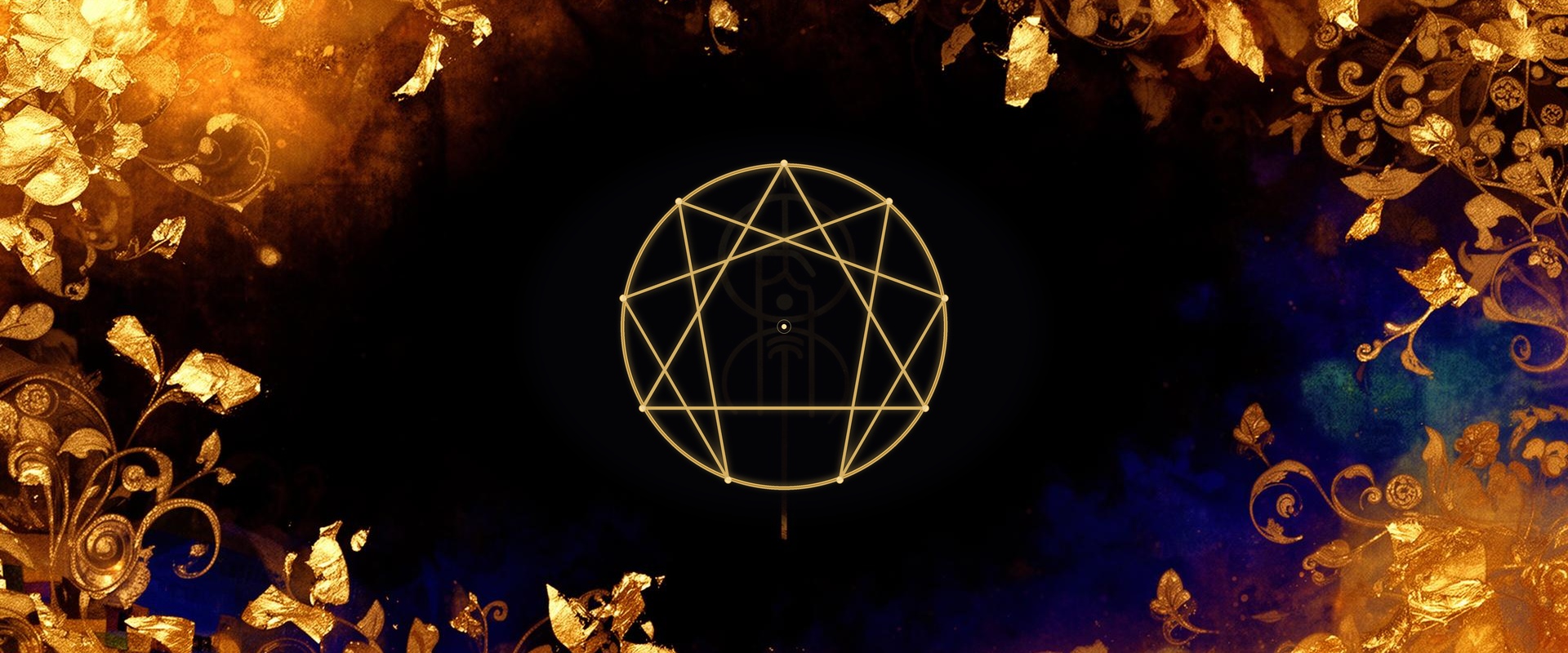
In contemporary culture the Enneagram is primarily known as a personality typology. Gurdjieff, who introduced the symbol to the West in the early twentieth century, used it as a process diagram: a map of how any event or process unfolds through time according to the Law of Seven and the Law of Three.
The 4th Tarot system restores the Enneagram to this original meaning in its Sacred Enneagram nine-card spread, also called the Naqsh-i-Nuh (Pattern of Nine). The nine positions map seven points of the Law of Seven around the outer circle, while the inner triangle formed by points 3, 6, and 9 maps the three shock points where conscious intervention is required for a process to complete rather than deviate. The hexad shows how energy actually moves beneath the observable surface of any process.
The Ray of Creation as Cosmological Map
Gurdjieff's Ray of Creation describes the hierarchical structure of the universe from the Absolute through successive levels of materiality: All Worlds, All Suns, the Sun, the Planets, the Earth, and the Moon. Each level operates under a greater number of laws; the Earth operates under 48 laws while the Moon operates under 96. Conscious development means bringing oneself under fewer laws, closer to the level of the Sun.
In the 4th Tarot Major Arcana, this cosmological map informs the progression of the card sequence. The Hermit (IX), linked to Viveka, represents the withdrawal required to receive higher influences that cannot reach a person enmeshed in mechanical life. The Star (XVII) represents the hope and guidance that become accessible after the Tower's demolition of false structures. The progression from the Moon (XVIII) to the Sun (XIX) maps the ascent from the 48 laws toward the 12.
Sanskrit Wisdom Traditions
The third lineage of the 4th Tarot is the Sanskrit philosophical tradition, drawing particularly on Vedantic frameworks of consciousness, the Bhagavad Gita's teaching on right action, and classical Sanskrit psychological vocabulary.
The Four Suits as the Four Centers
The most structurally significant Sanskrit contribution to the 4th Tarot system is the mapping of the 56 Minor Arcana cards to Gurdjieff's Four Centers through a Sanskrit cosmological lens.
Cups, the suit of Water, corresponds to the Emotional Center. Its Sanskrit terms trace the full arc of emotional life: from Prema (unconditional love, Ace of Cups) through Shoka (grief, Five of Cups) to Karuna (compassionate wisdom born from sorrow, King of Cups). The Cups suit introduces what the 4th Tarot identifies as the central distinction of emotional work: the difference between mechanical emotion and true feeling, which arises in the Higher Emotional Center when genuine attention meets genuine experience.
Wands, the suit of Fire, corresponds to the Moving Center and the Fourth Way's understanding of will as the organizing force of action. Its Sanskrit terms include Iccha Shakti (will-power, Ace of Wands), Dhairya (steadfastness under pressure, Seven of Wands), Titiksha (conscious endurance that transforms pain into wisdom, Nine of Wands), and Tejas (spiritual fire that radiates without consuming, Queen of Wands).
Swords, the suit of Air, corresponds to the Intellectual Center. The Ace of Swords carries Viveka Khyati, discriminative knowledge. The Two of Swords carries Avidya, willful blindness. The Eight of Swords carries Bandha (bondage), the mental chains created by wrong understanding. The Queen of Swords carries Paripakva, matured wisdom earned through suffering.
Pentacles, the suit of Earth, corresponds to the Instinctive Center. Its Sanskrit terms include Artha (rightful material prosperity, Ace of Pentacles), Karma Yoga (the yoga of action as spiritual discipline, Three of Pentacles), Abhyasa (sustained conscious practice, Eight of Pentacles), Parampara (lineage and succession, Ten of Pentacles), and Kubera (the Lord of Wealth who understands prosperity as stewardship, King of Pentacles).
Key Sanskrit Formulations in the System
The Nine of Cups carries Santosha and introduces one of the most precise distinctions in the 4th Tarot system: false contentment comes from getting what one wants; true santosha comes from being settled in one's essential nature regardless of outer circumstance. One comes from getting, the other from being.
The Six of Cups carries Bala Bhava (Childlike Nature / Earned Innocence), introducing the distinction between unconscious innocence (openness before testing) and earned innocence: the openness of someone who has passed through experience, suffered, integrated, and recovered genuine presence on the other side.
The Four of Swords carries Pratyahara, the yogic practice of sensory withdrawal. In the 4th Tarot this describes what Gurdjieff called the conscious rest between efforts: a deliberate withdrawal from outer stimuli not as avoidance but as integration. The interval between actions is itself a form of conscious work.
The Synthesis: How Three Traditions Become One System
Why These Three
Robert V. Nevans II, in the philosophical foundations of the 4th Tarot, describes Gurdjieff, Jung, and the Sanskrit sages as "not three separate rivers but one underground aquifer surfacing in different places." The Fourth Way provides the cosmological framework and the theory of psychological mechanism. Jungian depth psychology provides the cartography of the unconscious. The Sanskrit traditions provide a graduated vocabulary for states of consciousness and the concept of dharma as right action aligned with one's essential nature.
What the Synthesis Is Not
The 4th Tarot system is not a New Age eclecticism that borrows freely from multiple traditions without accountability to any. Each card carries exactly one Sanskrit term, one Jungian archetype or concept, and one Gurdjieff teaching: three positions in a structured triadic framework. The system is not a divination system. It is not derived from the Rider-Waite-Smith tradition. Robert V. Nevans II spent twelve years developing the philosophical coherence of the synthesis before the system was published.
How to Use the System
The 4th Tarot system meets seekers at multiple levels of engagement. A person with no prior knowledge of Gurdjieff, Jung, or Sanskrit philosophy can work with the cards through the basic card meanings and beginner spreads and receive genuine psychological insight. A seeker with deeper study behind them will find that the system opens further as knowledge of the source traditions deepens. The cards teach by repetition, by the friction of returning to the same image under different conditions of life, and by the slow accumulation of recognition that the archetypal forces depicted in 78 images are not external but interior: not descriptions of what is happening out there but mirrors of what has always been happening within. For practical questions about getting started, see the FAQ. To see how these principles come alive in actual readings, explore The Chronicles.