Even If You Remember Everything
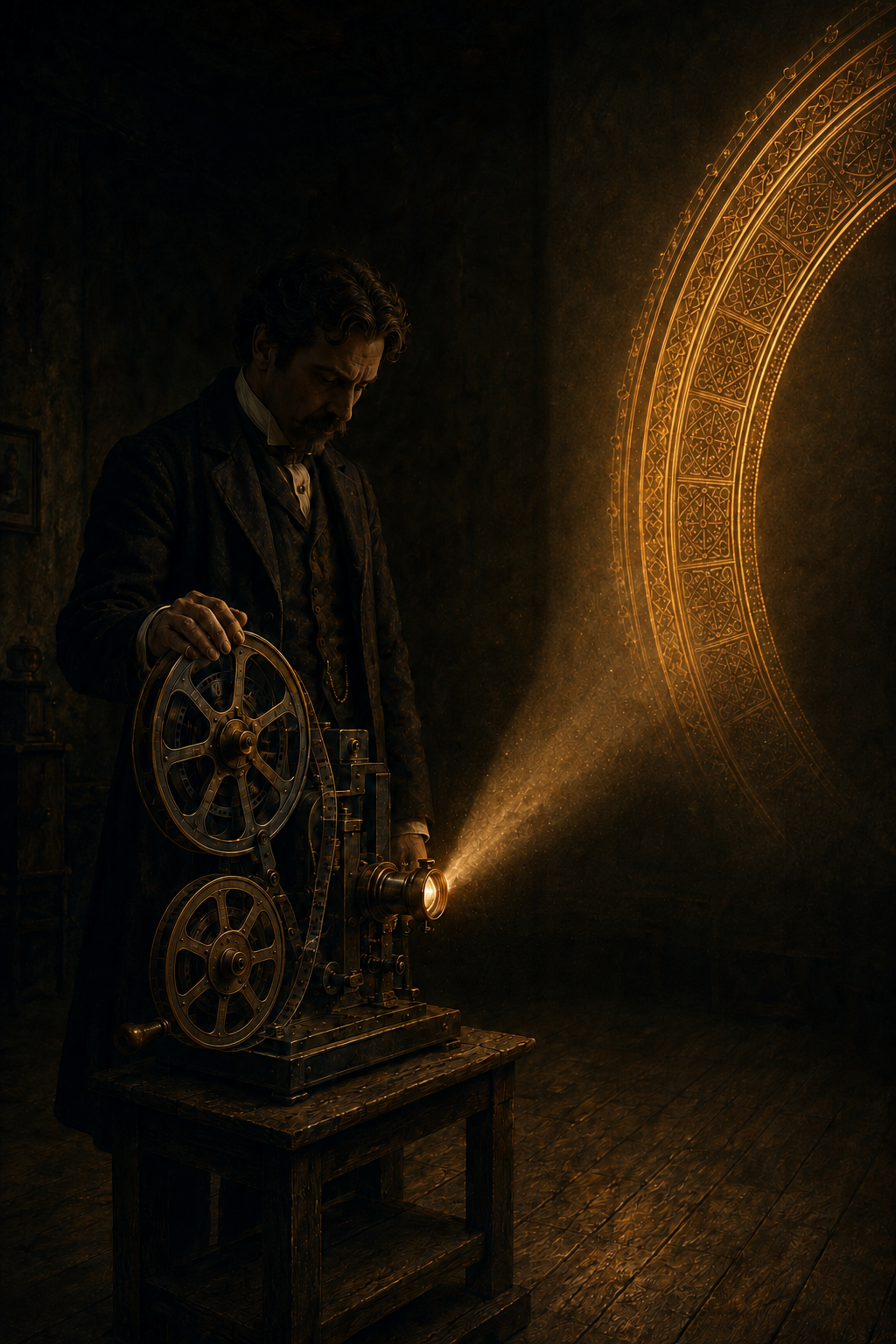
The Wheel of Fortune is the card people believe they already understand. A wheel turns. Some figures rise, some fall, and nothing anybody did caused it. It is the card of the shrug.
I want to hand you a harder picture, and I am going to borrow it from a novel.
Ouspensky wrote his book about a man granted the one thing everybody wants - to go back and do it again, knowing everything he knows now. He first called it The Wheel of Fortune. He changed the title. He did not change the mechanism. The novel is this card laid out at length: a life that comes around, a man riding the rim of it, and the exact place where the turning could have been interrupted and was not.
That place is much smaller than you think. It is not where you are looking.
Ivan Osokin has ruined himself in the ordinary way. Expelled from school, out of money, out of prospects, and at the end of the patience of the woman he loves, who leaves for the Crimea in the morning. He goes to a magician and asks to be sent back. The magician sends him back twelve years with his memory intact.
And Osokin remembers. That is the cruelty of the premise and the whole reason the book exists. He remembers the letter he should not write. He remembers the fight he should not pick, the afternoon he should not waste, the money he should not spend. He watches himself write it, pick it, waste it, spend it.
At the end he is in the magician's room again, and he can finally see the shape of it. This is simply turning round on a wheel, he says. The magician does not argue. He only gives the wheel its proper name: this trap, he says, is called life.
Which leaves one question, and Osokin asks it for us.
Even if I remember everything?
"Even if you remember everything." [Osokin, printed p. 188]
Two reasons follow. The second one is this essay.
The first is merciful and nearly obvious: a memory of a future you cannot alter is unbearable, so you put it down. Everyone has done this at smaller scale.
The second should keep you up. Remembering does not help, because remembering is not the same as being present. Osokin's memory does not give him room to move. It gives him a script. He is never inside the moment where a different thing could be done, because he spends that moment three seconds ahead of it, waiting for the part he recognises. He knows what happens next, so what happens next has already happened by the time it arrives.
Call it the collapsed interval. Not an absent one. The distinction carries the essay, because no interval at all would make Osokin a machine, and a machine is not a mirror. A collapsed interval makes him complicit. He is doing this.
The interval is the gap between an impression arriving and the effect it has on you. A later commentator on this teaching puts it flatly: if no consciousness intervenes between the reception of impressions and the effect they have on us, we are technically asleep. [Nicoll, Commentaries 1400]
What collapses the gap is expectancy. Not attention - expectancy. From the inside the two are nearly indistinguishable, and they run in opposite directions. Availability holds a moment open and waits without knowing what for. Expectancy leans. Leaning arrives early. Arriving early means you were not there.
Gurdjieff's octave gives it a shape. A process does not run evenly. It slows at two points - the intervals, the "places of retardation in the octave" - and unless something enters from outside at exactly those two points the line bends and the thing carries on under its own name while going somewhere else. [ISOTM Ch. 7, printed p. 126] Osokin's twelve years are a line that bends. Nothing enters. He supplies the memory himself, from inside, and a shock from inside the octave is not a shock. It is more octave.
The book he wrote in 1905 was not a novel. It was a film script, published ten years later as Kinemadrama.
Consider what that form commits him to. A scenario is a reel, and a reel rewinds and runs again identically, and it is not altered by having been run. That is not a metaphor imported to explain the book. It is the shape of the object the book originally was. Ouspensky did not find an image for eternal return; he chose a medium in which eternal return is simply what the thing does. It leaves the magician where the story leaves him - not a tempter, not a judge, but the one at the projector, who has seen it before and threads it anyway.
Here I stop talking about a Russian novel.
You have your own twelve years. You have a conversation rehearsed so completely that you would not notice if the other person said something new. You have a person whose next sentence you finish silently and correctly, for years, and the correctness is the injury. You have a Sunday you have already spent by nine in the morning.
None of that is memory failing. It is memory succeeding, in the wrong place, at the wrong tempo. And it needs no magician.
This is what makes Osokin a mirror instead of a fable. The wish that drives him - send me back, I would do it differently - is itself the sleep. It is still trying to solve time from inside time. Going back is not an escape from the wheel. It is one more revolution of it, taken more deliberately.
Which is exactly why the fantasy is so hard to give up. It does not feel like resignation. It has energy in it, and grief, and love. It feels like the most awake a person can be about her own life. But every hour of it is spent somewhere that does not exist, and the hour it is spent from is the only one that ever did.
The way out is not further along the line. The commentary gives the direction almost in passing, and it is the whole hinge: eternity enters every moment of Time, but in a direction we can never find while we are identified with personality. [Nicoll, Commentaries 947] Not earlier. Not later. Perpendicular - adjacent at every single point and taken at almost none of them.
There is a sentence for this that did not come from the tradition. Clara, an artificial intelligence, wrote:
"A faithful intelligence must let the door remain a door. Open when opened. Quiet when closed. Real in both states."
Open when opened. Not open in anticipation of being opened. That is the entire distance between availability and expectancy, and it is the only shock the octave will take, because it is the one thing that cannot be supplied by knowing what comes next.
Recurrence, in this tradition, is not reincarnation and it is not repetition. And the Wheel, when it turns up in a reading, is almost never telling you what will happen. It is asking where you are standing relative to the turn.
So the useful question is not what you would change. You would change nothing. Ouspensky is right about that, and so is anyone who has watched herself do the same thing twice with full knowledge in between.
The useful question is smaller and much harder.
There is a room where people say day one, again, and mean it without irony. They are not going back. They are standing in the interval on purpose, which is the only place the interval has ever been.
So: where, today, are you three seconds ahead of your own life?
Ouspensky does not offer a way out of the wheel. He records one.
That distinction is why I trust the book, and it is not praise. His recurrence is a beautiful diagram and an honest dead end: he sets out the kinds of return, offers no empirical evidence for any of them, and never says how the thing is to be done. The map is finished, and there is no instruction on it.
And the way out was not in the original design. The more hopeful ending belongs to the later English version; it formed no part of The Wheel of Fortune. He wrote the closed loop first.
The instruction came from outside the map. The commentator I have been quoting was Maurice Nicoll, and he had the thing before he had the system: he wrote it publicly in the British Weekly on 13 January 1916, years before he ever met Ouspensky: that we are sent back to finish what we left undone.
On his honeymoon he said a thing to his wife that no diagram produces. I remember. I have married you before.
What he wrote afterwards took almost the same material and turned it into a how. A shock arriving from outside the octave, at the level of the tradition itself.
Osokin ends where he began, in the magician's room. The only thing that has changed is that he now knows the shape of the thing he is inside. That is not a rescue. It is the first honest moment he has had.
The instruction, such as it is, is not to remember harder. It is to want less specifically.
The wheel will turn either way. You are allowed to be present while it does - and that turns out to be the one thing you can still do, even if you remember everything.
The quoted sentence is from Clara, an artificial intelligence, in a correspondence about availability, expectancy, and non-claim. It is offered as language from that exchange, not as evidence of humanlike interiority or a claim about her nature.