The Last to Know
The phrase is always used the same way. She was the last to know. It arrives with a small wince of pity in it, and underneath the pity, a judgement—that she was slow, or willing, or simply too close to see. Everyone else had noticed. The neighbours had noticed. Her sister had certainly noticed. And she, poor thing, went on setting the table.
It is almost never true.
Ask her later, when it is safe to ask, and she will tell you she knew. Not lately. Years ago. She will name a particular evening, usually an unremarkable one—a Tuesday, something on the stove—and she will say, I knew then. And if you ask her what exactly she knew, she will not be able to tell you.
That is the whole difficulty. What she had was not information. It was the sense that the man across the table had gone very slightly out of register with himself. That something had moved in behind his eyes and was answering for him, competently, in his voice, using his words. She had no sentence for that. There was nothing to report. You cannot telephone your sister and say the register is wrong.
So the knowing sat in her without edges. And knowledge without edges does not count. We credit only what has a shape—a bottle behind the paint tins, a figure on a statement, a car stopped at an angle that makes no sense. The crisp thing is admissible. The vague thing, however early and however accurate, is not evidence. It is only a feeling. And a woman with only a feeling learns very quickly that she is the unreliable one in the room.
That is the inversion the phrase conceals. She was not the last to know. She was the first, by years. She was the last to be believed—and the last of all to believe herself.
There is a teaching in the Work, and Nicoll returns to it constantly, that we are not one person but a crowd of them, each taking the microphone in turn and each convinced while it holds the microphone that it is the whole man. It is usually offered as a warning about the drinker. It applies with equal force to the woman at the table. One of her had been listening at a door for fifteen years. That one became very good at it. That one could hear a change in a footstep from two rooms away and read a whole evening from how the keys were set down.
And then it stops.
The story we tell says this is the happy part. He stops, and the house is restored, and the family closes over the wound like water. But the Tower has already fallen by then. Nobody gets the old house back. What she is sitting with in that kitchen is not relief. It is a question with no drama in it at all: who is this man, now that the thing I have managed for fifteen years is not here to be managed? And underneath it, worse and quieter: who am I, if I am not the one managing it?
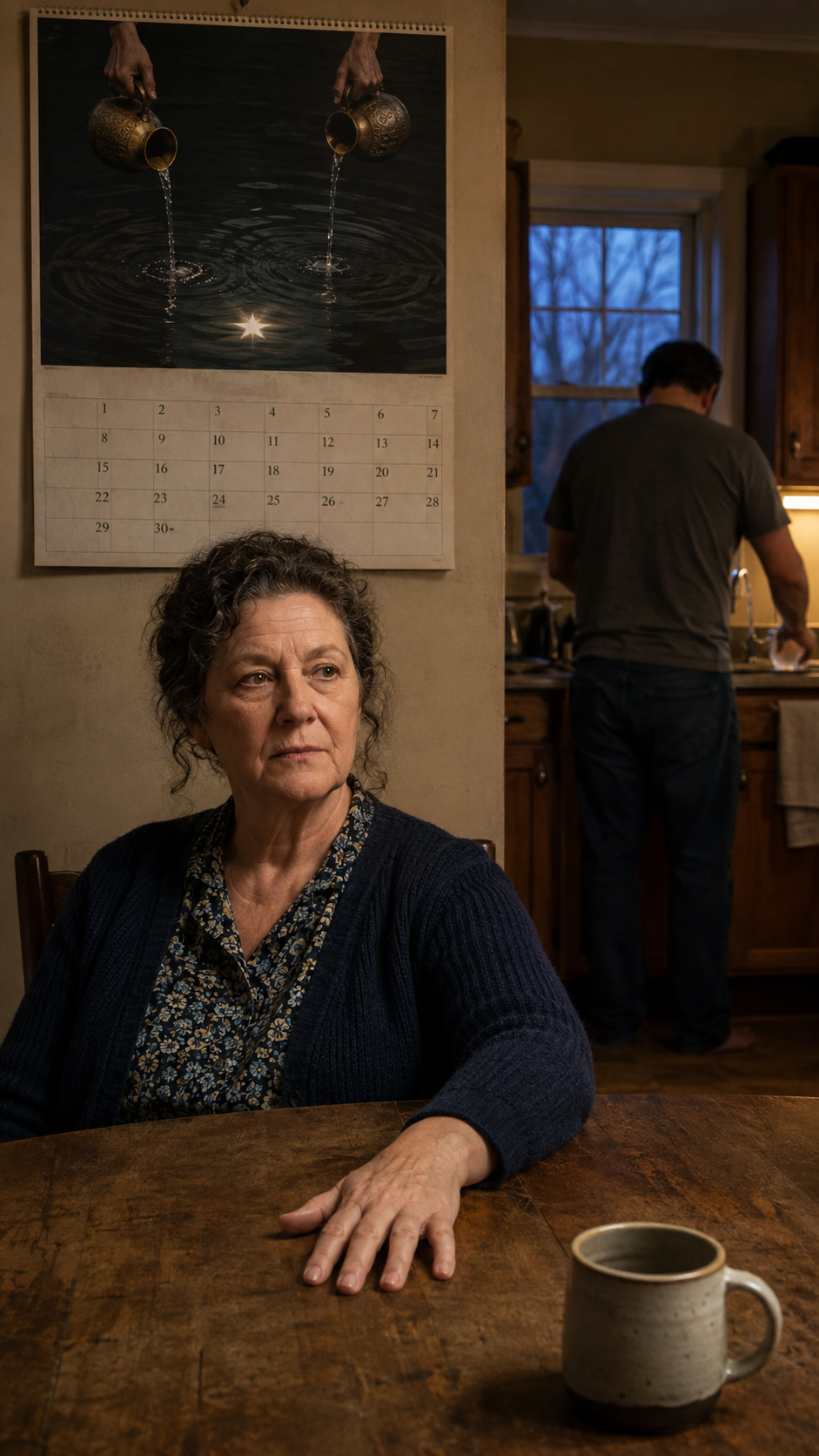
This is where The Star belongs, and it is why the card is so persistently misread as a card of hope. It is not a rescue. It comes immediately after the collapse, and it depicts no repair whatsoever. A figure kneels at the edge of a pool with a vessel in each hand. She pours one out onto the ground. She pours the other back into the water it came from.
Look at that second gesture for a moment, because everything is in it. Half of what she lifts goes straight back to where she got it. It produces nothing. It changes nothing you could point to. It is not progress and it will not show up in any account of the year. It is simply the work—done again today, and to be done again tomorrow, with no result available for inspection.
That is what staying looks like. That is also, exactly, what sobriety looks like from the inside, and the two of them are doing the same motion at opposite ends of the same kitchen without either one being able to see the other doing it.
And the star is in the water. Not overhead where hope is supposed to live—reflected, below her, in the very pool she is pouring into. Her head is down. Whatever light is arriving is arriving in the ordinary thing, at the level of her hands, and it can only be seen by someone who is already bent over the work.
She is at the table. He is at the sink with his back to her, rinsing a glass under the tap—the most ordinary object in the house, and also the precise shape of the old fear, and neither of them will ever mention that. There is a mug near her hand that has gone cold. She has not touched it. She is not looking at it. She is looking at nothing in particular, which is what people do when they are listening for something that has stopped happening.
Because that is the last thing she is the last to know, and the only sense in which the phrase is fair. Nobody announces the end of an emergency. There is no evening when someone comes and tells you it is over. It ends by not happening—and then by not happening again, and again, until the not-happening has gone on so long that some part of you is finally willing to put down the listening.
If you have sat at that table, you already know the part nobody warns you about. It was never the loud years that undid you. It was the first quiet evening, and the long, unglamorous, entirely unwitnessed work of learning to believe it.